Rock paper scissors feels as though it could have been invented anywhere: three hand shapes, a short countdown, and an immediate result. Its history is more interesting than that impression suggests. The familiar modern form is closely connected to Japanese janken, within a broader history of hand games and cultural exchange in East Asia.
There is no need to attach a precise ancient birthday to enjoy that story. Different sources describe different games, gestures, and social settings. This guide distinguishes the modern three-choice rules from older related traditions, explains what documentary evidence can show, and explores why such a small game travels so easily.
Start with the modern game
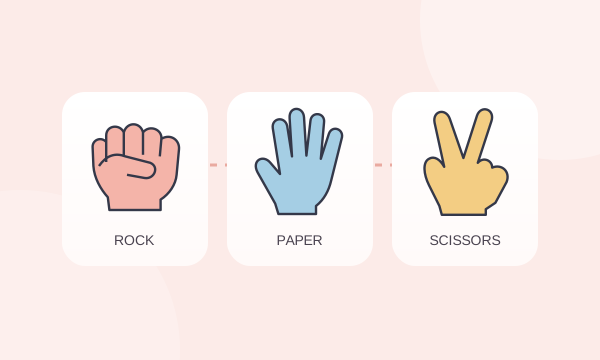
The version played on this website uses a closed fist for rock, a flat hand for paper, and two extended fingers for scissors. Each defeats one other shape and loses to another. Players make their choices privately and reveal them together. Matching shapes create a draw rather than a winner.
Our rules guide explains that cycle in detail. It is useful to establish this definition before discussing origins because not every historical hand game used these three objects. Calling all older finger games “rock paper scissors” can hide meaningful differences in their rules and purpose.
Earlier Chinese hand-game traditions
The Japan Foundation’s Irodori cultural notes on janken describe roots in old Chinese hand games and the development of the current form in Japan around the Edo period. This supports a broad account of cultural transmission, rather than proof that the exact modern gestures existed at a particular ancient date.
A related tradition can influence a later game without being identical to it. Think of the distinction between a family of card games and one specific modern ruleset. Shared materials or gestures establish a connection, but a historian still needs evidence before assigning the same rules to every example in that family.
This is why repeated online claims about a single inventor or a precise origin thousands of years ago deserve scrutiny. Ask what source is being cited, what game it actually describes, and whether the writer distinguishes a predecessor from the modern version. A confident date without that context is not necessarily useful evidence.
Janken and the wider Japanese context
The familiar Japanese name janken connects the modern game to a larger category of ken, or finger games. A Library of Congress account of its Japanese Rare Book Collection discusses an 1830 manual, Ken hitorigeiko, and explains that earlier finger games were also adult entertainments. That is a useful correction to the assumption that these games have always belonged only to children.
The manual is evidence of a documented finger-game culture, not a birth certificate for the current rules. The Library’s discussion emphasizes variety and social context. Books, images, and accounts of gatherings can tell us how people played and represented games, while leaving other questions about their earliest development unresolved.
Objects help, but need interpretation
A museum image of people making gestures can be valuable historical evidence. It does not automatically tell us the full rules, the spoken cue, or whether the depicted round was scored in a familiar way. Those details may require accompanying text or comparison with other sources.
The Fukuoka City Museum’s Ken, a Game of Gestures, attributed to Utagawa Kuniyoshi, provides another institutional view of this tradition. Its description connects ken with transmission from China to Japan in the early Edo period. Again, that is evidence about a related tradition rather than a precise invention moment for our current browser game.
How the game crossed borders
TeachingHistory.org’s historian response on rock paper scissors points to Stewart Culin’s 1895 Korean Games, which describes Japanese janken among East Asian hand games. The response identifies that Japanese game as a likely source of the modern Western form, while treating the exact route of transmission cautiously.
The Library of Congress also describes a 1906 American newspaper advertisement for a Jan-Ken-Po card game. This shows a Japanese-named game reaching a particular commercial setting, rather than proving that every household already knew the hand game. Evidence of one appearance establishes an example, not instant universal adoption.
There may be several paths of transmission: travelers, migrants, printed descriptions, commercial games, and ordinary person-to-person teaching. A game that requires no special equipment can move through informal settings that leave little written record. That makes the earliest surviving mention important, but not necessarily the first time anyone played it in a country.
Why names and cues vary
Some English speakers say “rock paper scissors,” while others say “paper scissors stone.” The word order can change without changing the three-way cycle. Countdown customs also differ. One group reveals on the final object; another adds “shoot.” These variations are best settled by agreement before a scored round.
Differences in names show how a game can become familiar in local speech. They do not by themselves demonstrate a separate invention. Conversely, two games with similar gestures may have different objectives or follow-up rules. Compare what players actually do, not only the labels they use.
From everyday decisions to deliberate matches
Rock paper scissors works as a small decision tool because both participants have the same options and can see the outcome quickly. People can use it to choose who starts an activity, settle a playful disagreement, or create a short competition. The game’s simplicity makes explanation and repetition inexpensive.
Organized play introduces practical questions: what counts as a late reveal, who resolves an unclear gesture, and how many wins finish a match? Those issues are understandable even without claiming a single worldwide governing tradition. Best of 3 and Best of 5 are clear formats when everyone agrees that draws do not award points.
The digital version changes the setting
A browser game replaces physical gestures with buttons and a shared reveal display. Against a computer, it also changes the opponent: an independent random sampler has no social habits to read. Against another person sharing the screen, secret selections need an explicit handoff so the second player cannot casually inspect the first choice.
The homepage game uses both of those approaches while preserving the classic three-choice cycle. It does not recreate historical ceremonies or claim to be an official competition platform. It is a modern way to enjoy familiar rules with clear scoring, accessible controls, and quick rematches.
Modern variations keep the central idea
A variation can preserve simultaneous choice while expanding the option set. Our Lizard Spock guide describes one five-choice example, credited by Sam Kass to himself and Karen Bryla. Each move has two wins and two losses, extending the balanced structure rather than making one gesture unbeatable.
Comparing variations helps reveal what matters in the classic game: equal access to choices, concealed decisions, and agreed relationships. More options create additional rules to learn, while the original three remain easy to explain. Neither approach needs to replace the other for players to enjoy both.
Frequently asked questions
Who invented rock paper scissors?
The sources discussed here do not identify one securely documented inventor of the modern classic game. The safer account describes development through related hand-game traditions and Japanese janken. A single named inventor would require stronger evidence than a frequently repeated online claim.
Is the modern game exactly the same as ancient hand games?
That should not be assumed. Earlier games may share finger gestures or a cyclical relationship while differing in their shapes, social purpose, or scoring. Distinguishing predecessors from the modern rules makes the history more accurate rather than less interesting.
Why has it remained so easy to share?
It needs little explanation, no purchased equipment, and only a moment to reveal a result. Those design features make it convenient to teach in many settings. That is an explanation of its practical appeal, not a measured claim about popularity in every country.
A history worth keeping nuanced
The strongest story is one of adaptation and exchange, supported by specific documents and careful distinctions. You can appreciate the connection to janken without claiming certainty about every early stage. The next time you choose a move, you are taking part in a compact game whose simplicity has allowed many people to make it their own.