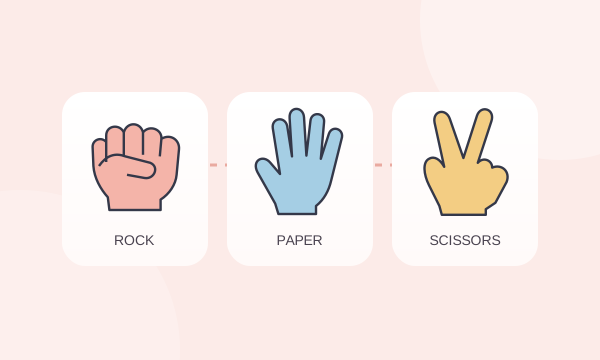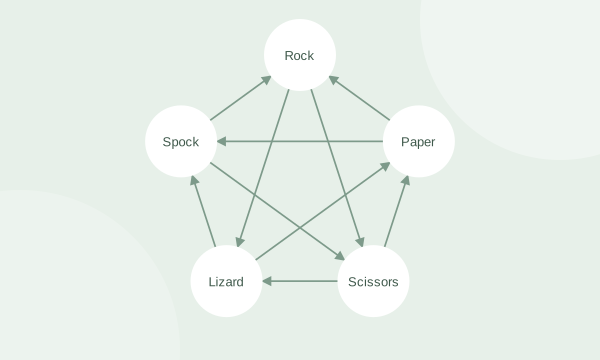
Rock Paper Scissors Lizard Spock extends the classic game from three moves to five. The central idea stays familiar: players choose secretly, reveal together, and compare their gestures. Each move now beats two others and loses to two others, producing ten distinct winning relationships instead of the classic three.
This is an informational guide to playing the variation with another person. The game on our homepage remains classic three-choice rock paper scissors. It does not include selectable lizard or Spock moves. Learn the expanded rules here, then agree on the gestures with your friend before trying them in person.
Where the variation comes from
Sam Kass credits himself and Karen Bryla with creating the variation on his original rules page. That page is a useful primary source for the rule relationships and creator attribution. You may encounter the words in a different order, including “Rock Paper Scissors Spock Lizard,” while referring to the same system.
The important feature is the balanced relationship structure. Adding two names is not enough by itself: each needs clearly defined wins and losses. The result is a five-choice game in which no move dominates the others. Knowing all ten pairings prevents arguments when an unfamiliar combination appears.
The five gestures
Rock is a closed fist, paper is a flat open hand, and scissors uses two extended fingers. Lizard is commonly represented by fingers and thumb forming a small mouth. Spock uses a split-finger greeting shape. Demonstrate the gestures slowly before starting so both players know what a valid choice looks like.
Some people cannot comfortably make the usual Spock gesture. Agree on a clear substitute if necessary, such as showing a labeled card. The rules depend on distinguishable choices, not a test of finger flexibility. Whatever substitute you use, choose it in advance and keep it consistent throughout the match.
Complete winning table
| Move | Beats | Loses to |
|---|---|---|
| Rock | Scissors, Lizard | Paper, Spock |
| Paper | Rock, Spock | Scissors, Lizard |
| Scissors | Paper, Lizard | Rock, Spock |
| Lizard | Paper, Spock | Rock, Scissors |
| Spock | Rock, Scissors | Paper, Lizard |
Every row contains two wins and two losses. A move also draws against itself, which is the fifth possible opposing choice. If a proposed rules chart gives a gesture three wins and only one loss, it is describing a different or mistaken system rather than this balanced variation.
All ten winning relationships
Rock crushes scissors and crushes lizard. Paper covers rock and disproves Spock. Scissors cuts paper and decapitates lizard. Lizard eats paper and poisons Spock. Spock vaporizes rock and smashes scissors. These descriptions are a memory aid for symbolic game relationships; players simply compare gestures rather than act them out.
One way to learn the system is to begin with the familiar three relationships, then add the seven involving lizard or Spock. Keep the table nearby for the first few matches. It is better to pause and check than to let the fastest or most confident player decide an unfamiliar outcome incorrectly.
Learn one move at a time
Start with lizard. It wins against paper and Spock, but loses against rock and scissors. Once that is comfortable, learn Spock: it wins against rock and scissors, but loses against paper and lizard. Then return to the original three and add each move’s new relationship.
Notice that lizard and Spock help organize the memory task. Lizard’s wins are the two choices that beat rock. Spock’s wins are rock and scissors. You do not need to memorize a fast spoken chant if that feels confusing; a quiet table or a simple relationship diagram works just as well.
Playing a clear round
Agree on the reveal cue, make a private choice, and reveal simultaneously. If both players show the same gesture, record a draw and repeat. If the gestures differ, use the table to identify the winner. Do not change a hand shape after seeing what the other player selected.
For example, imagine Alex chooses paper and Noor chooses Spock. Paper wins because it disproves Spock. If Alex chooses lizard next and Noor chooses scissors, Noor wins because scissors defeats lizard. If both then choose rock, neither earns a point. Each comparison is independent of the previous round’s winner.
Best of 3 and Best of 5
You can use the same match targets as in the classic game. Best of 3 ends when one person earns two decisive wins. Best of 5 ends at three. Draws do not reduce the number of wins required. Agree on the format before starting so neither player changes the target after falling behind.
Suppose a Best of 3 begins with a lizard/lizard tie. Player 1 then wins with Spock over rock, loses with paper against scissors, and wins with rock over lizard. The final score is 2–1 after four attempts. Our classic rules guide explains the same draw-and-target distinction in more detail.
Does the variation reduce ties?
If both players choose independently and uniformly from five moves, the probability of a tie is one fifth. Hold one player’s move fixed: just one of the opponent’s five equally likely choices matches it. The other four divide evenly between two wins and two losses, giving each a probability of two fifths.
Under the comparable three-choice model, the tie probability is one third. That mathematical comparison depends on uniform independent choices. Friends who repeatedly favor the same gesture may tie more often than the model predicts. Do not treat a theoretical reduction as a guarantee that your next session will contain fewer draws.
Strategy without exaggerated promises
Adding moves does not create a universally winning gesture. Against a uniform opponent, every choice has the same two-fifths win chance. Against a person, a preference may be exploitable: someone who always chooses Spock can be beaten with paper or lizard. They can also notice your response and adapt.
The probability guide explains why equal move frequencies and unpredictable ordering are different ideas. Cycling mechanically through all five gestures uses each equally often but remains predictable. Try to understand the opponent’s actual behavior without assuming that a clever-sounding pattern guarantees success.
Common learning mistakes
The first mistake is applying only the original three rules and guessing whenever a new move appears. The second is reversing paper versus Spock or lizard versus paper. Keep the chart visible until those pairs feel familiar. Check the winner from both perspectives if two players disagree.
Another mistake is introducing new gestures mid-match. A player who did not know lizard was available cannot make an informed choice from the same option set. Explain the entire variation before the first scored round. If someone wants to return to the simpler game, finish or reset the current match together.
Frequently asked questions
What beats Spock?
Paper and lizard beat Spock. Spock beats rock and scissors, and another Spock creates a draw. Those five cases account for every possible opponent move in this variation.
What beats lizard?
Rock and scissors beat lizard. Lizard beats paper and Spock, and two lizards draw. Remembering this complete row can be easier than memorizing separate isolated phrases.
Is this variation available in the browser game?
No. This website’s playable experience uses rock, paper, and scissors only, with computer and local two-player modes. This article teaches the five-choice variation for informational purposes and for play away from the website.
Keep the first match simple
Use a visible rules chart, choose a short match, and allow time to check each outcome. Once all five gestures are clear, the game becomes a familiar simultaneous-choice contest with a larger set of possibilities. The extra fun comes from learning the relationships together, not from rushing someone who is still practicing.