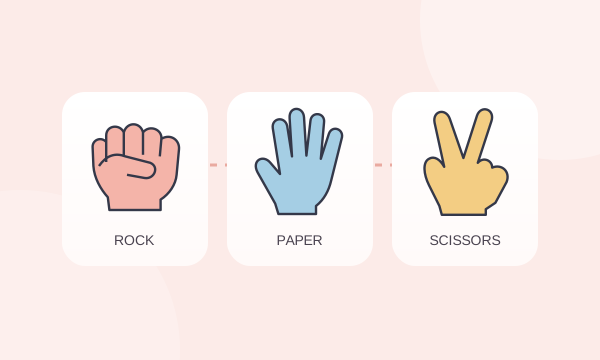
Rock paper scissors has three choices and a wonderfully short rulebook. Rock beats scissors, scissors beats paper, and paper beats rock. Two matching choices make a draw. That cycle is the whole foundation: every move wins against one option and loses against another, so none is automatically the strongest.
This guide explains the practical details that prevent arguments: when to reveal, how to score ties, when a match ends, and how to play fairly on one screen. You can try each example in the free homepage game, then use the same rules away from the browser with nothing more than your hands.
The three hand shapes
Make rock with a closed fist. Make paper with an open, flat hand. Make scissors with two extended fingers. Agree on those shapes before playing, especially with younger players who are learning to distinguish the gestures. A clear shape is more useful than an elaborate motion.
The names describe imaginary relationships rather than a test of real materials. Paper covers rock; rock crushes scissors; scissors cuts paper. You do not need to debate whether particular scissors could cut a particular sheet. The relationships are fixed game rules, and they stay the same in every round.
| Your move | You win against | You lose against | You draw against |
|---|---|---|---|
| Rock | Scissors | Paper | Rock |
| Paper | Rock | Scissors | Paper |
| Scissors | Paper | Rock | Scissors |
Read across a row from your own perspective. If you choose paper and your opponent chooses scissors, your result is a loss. From your opponent’s perspective, that exact same round is a win. Recording results from a consistent perspective avoids reversing scores halfway through a match.
Agree on a simultaneous reveal
For an in-person game, agree on the cue before starting. You might say “rock, paper, scissors, shoot” and reveal on “shoot.” Another group may reveal on “scissors.” Neither convention is a problem when both people know which one applies. A disagreement about timing should be resolved before anyone earns a point.
Keep your choice unchanged after the reveal. Watching an opponent open their hand and then switching your fist into scissors defeats the purpose of a simultaneous-choice game. If one person reveals noticeably late, replay the round using an agreed cue rather than inventing a winner from an unclear exchange.
Playing in the browser
Against the computer, select one of the three illustrated buttons. The computer locks an independent random choice, the brief reveal completes, and both moves appear with an explanation. You do not need to time your click against an animation. The game compares the two locked choices for you.
In local two-player mode, Player 1 chooses privately and passes the device. Player 2 confirms readiness and chooses while the first move remains hidden. Both choices are then revealed together. This helps prevent casual peeking, but players should still turn away while the other person selects.
How a draw works
A draw means both choices match: rock against rock, paper against paper, or scissors against scissors. Neither side earns a win. Our game records the draw in its own column so you can see what happened without changing the winning target. Press the next-round button and choose again.
You are allowed to repeat the move you just used. There is no standard rule requiring a switch after a tie, a win, or a loss. For example, two consecutive paper draws can be followed by a third paper choice. Whether repetition is a useful tactic is a separate question covered in the strategy guide.
Best of 1, Best of 3, and Best of 5
Best of 1 requires one decisive win. A draw cannot finish the match because nobody has won. Keep playing until one person earns that point. This is the quickest format when you want to choose who goes first in another activity or make a small, mutually agreed decision.
Best of 3 means first to two wins. The match can finish 2–0 or 2–1. Best of 5 means first to three wins, allowing final scores of 3–0, 3–1, or 3–2. The names describe the maximum number of decisive rounds, not a limit on all attempts including draws.
A worked Best of 3 match
Suppose Maya chooses rock and Leo chooses scissors. Maya leads 1–0. Both then choose paper, producing a draw; the score remains 1–0. Next, Maya chooses scissors and Leo chooses rock, bringing the match to 1–1. Finally, Maya chooses paper against Leo’s rock and wins the match 2–1.
Four attempts were needed, but only three were decisive. The tied attempt did not use up Maya’s chance to reach two wins. The same principle applies to Best of 5: even a long run of draws leaves the target at three. Stop as soon as either side reaches the target.
Infinite mode and fresh starts
Infinite mode has no automatic match winner. Wins, losses, and draws accumulate until you decide to start over. It works well for learning the rules because there is no match-ending interruption after a small number of points. You can experiment with each move and read the explanation after every reveal.
Changing format starts a new active match so scores from different targets are not mixed. The website asks before discarding progress. Lifetime statistics are separate from the current scoreboard: starting another match does not erase your previous rounds. Use the statistics reset control when you specifically want to clear those saved totals.
Common mistakes to avoid
The most frequent rule confusion is treating rock as universally powerful. It beats scissors but loses to paper. Another is awarding half a point for a draw while still using a first-to-two target. That can be a house rule, but it is not the scoring system used here.
A third mistake is continuing a finite match after someone has already won. At 2–0 in Best of 3, a third decisive round cannot change the winner. Start a new match instead. Also make sure both players agree whether the score counts rounds or completed matches; these are different measures.
Frequently asked questions
Can paper really beat rock?
Yes. Paper covers rock in the game’s fixed relationship cycle. It is a symbolic rule, not a physical demonstration. If you remember that each move must beat one other move and lose to one, paper’s role becomes easier to recall.
Do draws count as a round?
They count as attempts and appear in the draw total, but they do not count as a win for either side. A Best of 3 match may therefore take more than three attempts. Only decisive results move a player toward the target.
Is there a best first move?
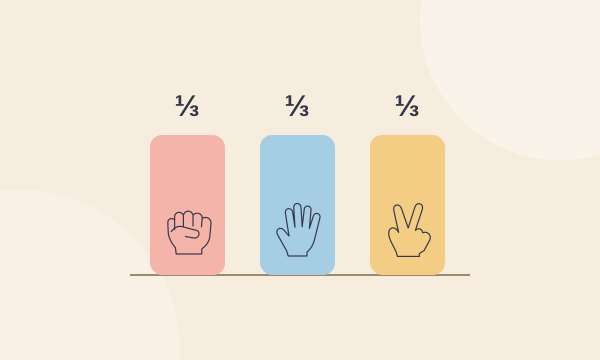
There is no inherently best first move against a uniformly random computer. Each option has the same theoretical chance to win, lose, or draw. Our probability guide explains why those equal chances do not guarantee a balanced score in a short session.
Can two people play on different devices here?
No. The local two-player option is for two people sharing one device. There are no online rooms, invitation codes, or remote opponents. If you are playing together in person, keep selections private and follow the handoff screen between turns.
Put the rules into practice
Start with Best of 1 and read the winning explanation after each attempt. Then try Best of 3 to see how draws and decisive wins interact. Once the cycle feels familiar, you can spend less attention remembering the rules and more enjoying the small surprise of each reveal.