Winning at rock paper scissors starts with knowing what kind of opponent you face. A person may repeat a favorite move or react to a previous loss. A uniformly random computer has no such preference to read. Advice that mixes those two situations can make a simple game sound much more predictable than it is.
There is no guaranteed winning sequence. This guide gives you a practical way to observe people, test a tentative prediction, and avoid confusing a lucky result with a reliable method. Use the homepage game for quick practice, or choose local two-player mode to compare your ideas with a friend on the same device.
Start with the balanced rules
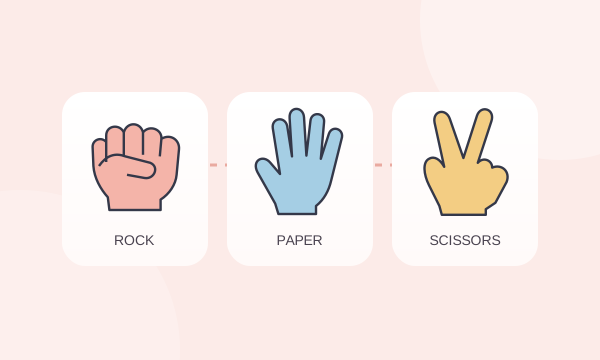
Every move has one winning matchup and one losing matchup. Rock beats scissors, paper beats rock, and scissors beats paper. Before thinking about psychology, make sure those relationships are automatic. A good prediction is useless if you accidentally select the move that loses to the choice you expected.
For a refresher, the complete rules guide includes a comparison table and worked match. Learn to name both directions: rock beats scissors, but paper beats rock. Thinking in pairs makes it easier to translate an observation into a response without assuming that one gesture is generally stronger.
Why no strategy wins every time
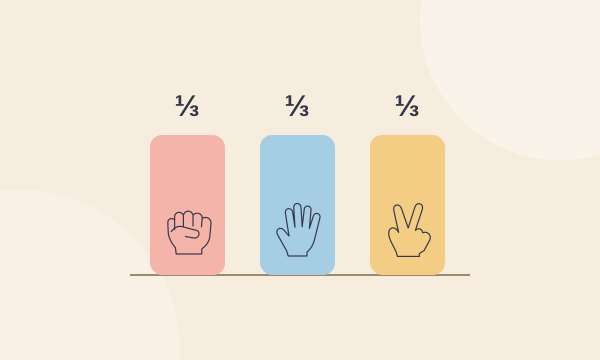
Against an independent opponent that selects each move with probability one third, every choice you make has a one-third win chance. Repeating rock, alternating two moves, and inventing a complicated sequence all face the same distribution on the next round. Your choice cannot change the opponent’s independent probabilities.
That does not mean you cannot win a match. It means you cannot guarantee one by following a secret pattern. You may win several rounds in a row and then lose several. The probability article explains these streaks and why a previous loss does not make a future win overdue.
Watch a person before making a claim
Against a human, pay attention to what actually happens. Do they repeat after a win? Do they avoid using the same gesture twice? Do they move through a recognizable order? Each is a hypothesis worth checking, rather than a rule you should impose on everyone you meet.
Imagine your friend wins with scissors and repeats scissors on the next two opportunities after winning. Rock might be a sensible response the next time that situation occurs. However, your friend could notice your response and change. A human opponent is an adapting participant, not a machine running your initial theory forever.
Keep observations small and specific
Instead of saying “people always choose rock first,” say “this opponent opened with rock in our last three matches.” The second statement describes your evidence and its limits. Three observations are still a small sample, but they are more useful than a sweeping claim about every player.
If you keep notes, separate opening moves from later responses. Someone might open with rock but prefer paper after losing. Combining every choice into one total can hide that difference. You do not need elaborate statistics during a friendly game; a simple tally can help you notice when your memory is selective.
Win-stay and lose-shift behavior
Researchers Wang, Xu, and Zhou examined repeated rock paper scissors in a controlled laboratory setting. Their study reported conditional responses and population-level cycling rather than perfectly independent behavior. It supports taking recent outcomes seriously when studying people, but it does not prove that every opponent follows the same predictable sequence.
The paper, Social cycling and conditional responses in the Rock-Paper-Scissors game, concerns a particular experimental setup with repeated play and random pairing. A casual match with one friend differs from that setting. Treat its findings as evidence that human patterns can exist, not as a universal script for your next throw.
“Win-stay” means repeating after success. “Lose-shift” means changing after failure. Even if someone shifts after a loss, there are two possible alternatives. Knowing that they may change is weaker information than knowing which replacement they favor. That distinction is often lost in overly confident lists of winning tricks.
Avoid becoming easy to read
Using each move equally often does not necessarily make you unpredictable. The sequence rock, paper, scissors, rock, paper, scissors has equal totals, yet a friend who recognizes the order can counter it. Frequency and ordering are separate ideas. Think about both when reviewing your own play.
Do not turn “never repeat” into a rule either. If you refuse to repeat rock after choosing it, you have removed one possibility from your opponent’s next prediction. Repetition is allowed, and genuine randomness naturally includes repeated moves. You do not need to make every short sequence look nicely balanced.
A practical training exercise
Play a short local session and let one person deliberately repeat after every win. Ask the other player to identify the tendency without announcing it. Then switch roles and use a different pattern. The aim is to practice forming and revising a hypothesis, not to prove that a tactic beats every human.
Afterward, discuss which observations were persuasive and which were coincidences. If a player predicted correctly once, ask whether their reasoning would have made the same prediction before the result appeared. This helps distinguish an actual forecast from an explanation invented after seeing the outcome.
Opening moves and match length
An opening move provides little direct information when you have never played the opponent. Without reliable evidence of a preference, rock, paper, and scissors remain defensible choices. Claims that one is always the optimal opener usually assume a population bias that may not apply to the person in front of you.
Best of 3 ends at two decisive wins; Best of 5 ends at three. The longer format gives you more opportunities to observe, but it is still a tiny sample for strong statistical conclusions. Draws add attempts without moving the winning target. Do not confuse a longer conversation about the game with strong predictive evidence.
Common strategy traps
One trap is changing your explanation after every result. If rock wins, you call it intimidating; if it loses, you say the opponent expected intimidation. A theory that can explain every possible outcome after the fact may not help predict anything. Decide what you expect before selecting your move.
Another trap is chasing a loss. A frustrating round can make you rush, repeat automatically, or abandon a reasonable plan. Take a moment and start the next round deliberately. This game should remain a light activity, and stopping a session is always an option when it stops being enjoyable.
Frequently asked questions
Can I beat the computer consistently with psychology?
Not this computer. It samples independently without reading your previous moves or trying to react emotionally. It has no favorite gesture, confidence, frustration, or desire for revenge. Human-reading tactics cannot exploit those nonexistent traits.
Should I always change after losing?
No. Changing can be reasonable if you have evidence about your opponent’s next choice, but an automatic switch can itself become predictable. Evaluate the opponent rather than treating your own previous result as an instruction.
Does faster clicking improve my odds?
No. The browser game compares locked choices rather than reaction times. Clicking faster does not intercept a reveal or change the computer’s probabilities. Pick comfortably and let the game finish the round before continuing.
A better goal than a magic trick
Aim to understand your opponent and your own habits. Against a person, make modest predictions and revise them when evidence changes. Against the computer, enjoy fair uncertainty. Either way, the most useful skill is knowing the difference between an observation, a hypothesis, and a guarantee you cannot honestly make.